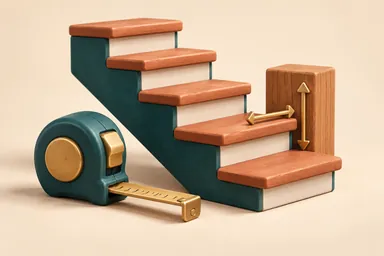






What is Stair Calculator?
Stair Calculator helps you explore stair count and dimensions from rise and step assumptions.
The main result is number of risers, with a breakdown of actual equal riser height, treads excluding upper landing and straight horizontal run. The formula, example and assumptions below explain how to interpret it.
How to use Stair Calculator
Use the example to get familiar with the form, then enter your own figures. Any rates in the example are illustrative. Check the field labels and units before calculating.
- Gather floor-to-floor rise (mm), target maximum riser height (mm) and tread depth / going (mm). Use values from the same situation or reporting period.
- Replace the example floor-to-floor rise with your own value, then complete the other fields. Check the displayed units.
- Select Calculate and read number of risers with its result breakdown. Change one input and calculate again to compare a second scenario. Reset restores the original example.
- Enter floor-to-floor rise in mm, at least 1. Decimals are accepted.
- Enter target maximum riser height in mm, at least 1. Decimals are accepted.
- Enter tread depth / going in mm, at least 1. Decimals are accepted.
Stair Calculator: a worked example
With the inputs below, the result is 18 (number of risers). Follow the example, then replace these illustrative values with your own.
| Input or output | Example value |
|---|---|
| Floor-to-floor rise (mm) | 3,000 mm |
| Target maximum riser height (mm) | 175 mm |
| Tread depth / going (mm) | 280 mm |
| Number of risers | 18 |
| Actual equal riser height | 166.666667 mm |
| Treads excluding upper landing | 17 |
| Straight horizontal run | 4,760 mm |
Understanding the Stair result
Read number of risers alongside actual equal riser height, treads excluding upper landing and straight horizontal run. These describe different parts of the same calculation.
Displayed results use a readable number of decimal places. When checking a result by hand, keep extra precision until the last step. To compare scenarios, change one input at a time and keep the others fixed.
- Example Actual equal riser height: 166.666667 mm
- Example Treads excluding upper landing: 17
- Example Straight horizontal run: 4,760 mm
Stair Calculator: assumptions and common mistakes
A useful estimate starts with the right inputs. Check the following assumptions and limits before applying the result to your situation.
- Keep dimensions in the displayed units and distinguish usable area from built-up area. Material estimates need a suitable allowance for site conditions and waste.
For wider guidance, visit Bureau of Indian Standards. The formula and scope of this specific tool are stated on this page.
