Organise consultation, test and medicine charges into a readable medical expense record. Enter only the patient details needed for billing, and match the amounts to the provider’s records. Separate consultation, investigation, medicine and other supported charges so the amount is easy to reconcile. Use the actual treatment dates and provider reference, and avoid adding unnecessary health information to a billing record. Review the patient name and each charge before sharing, while keeping the provider-issued invoice and any insurer-required documents with the expense file. Start with the medical bill generator for itemised expense records.
The record and the example used here
A medical bill records charges. It is different from a diagnosis, prescription or insurer approval. Keep treatment documents separate from the billing copy unless the recipient actually needs them.
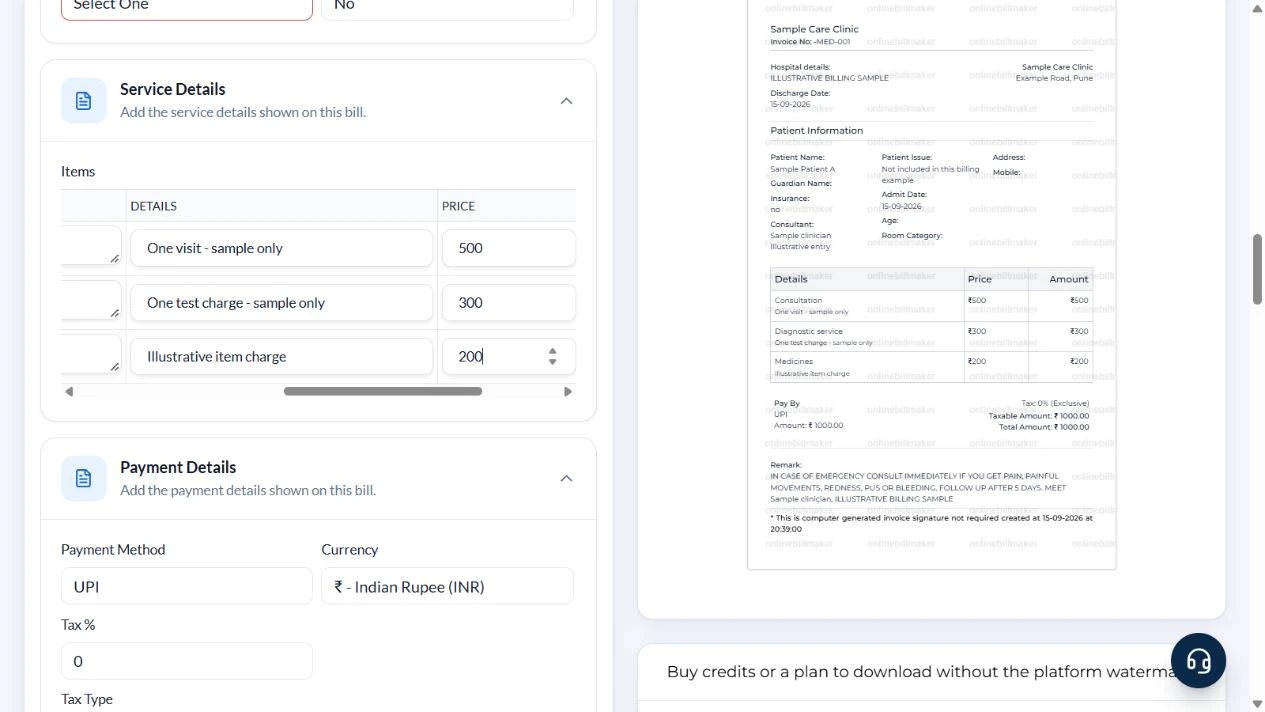
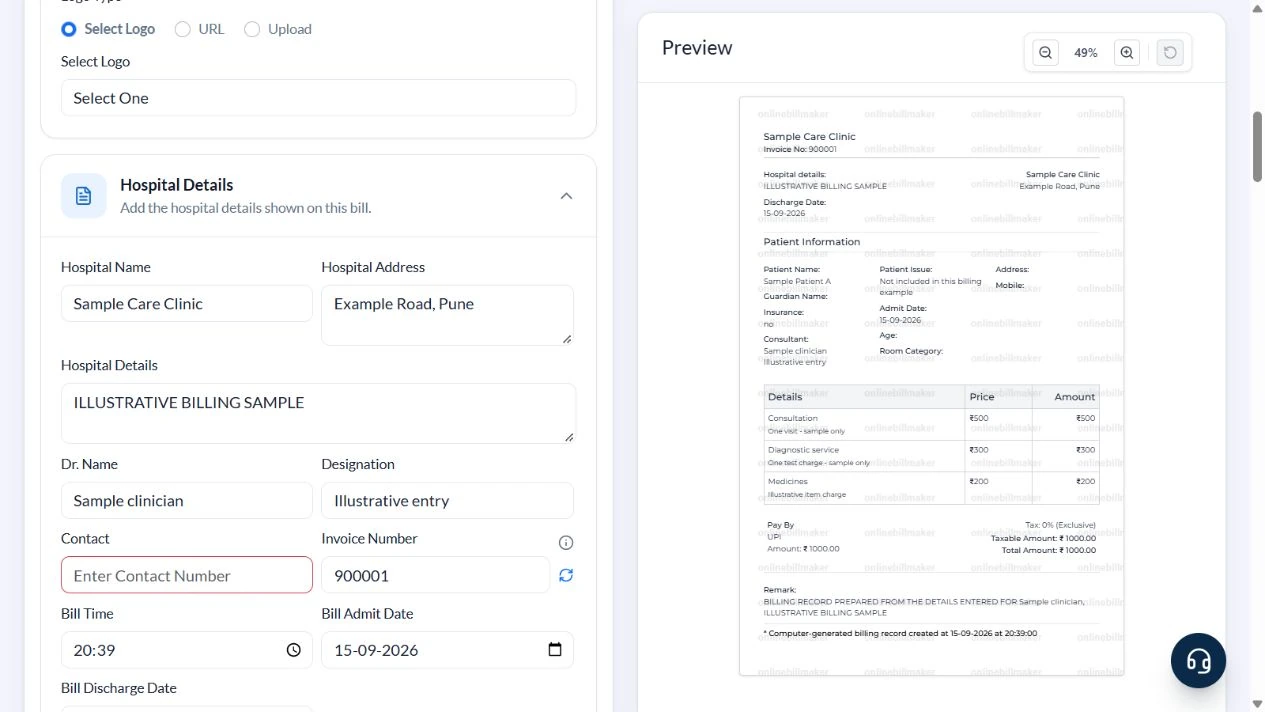
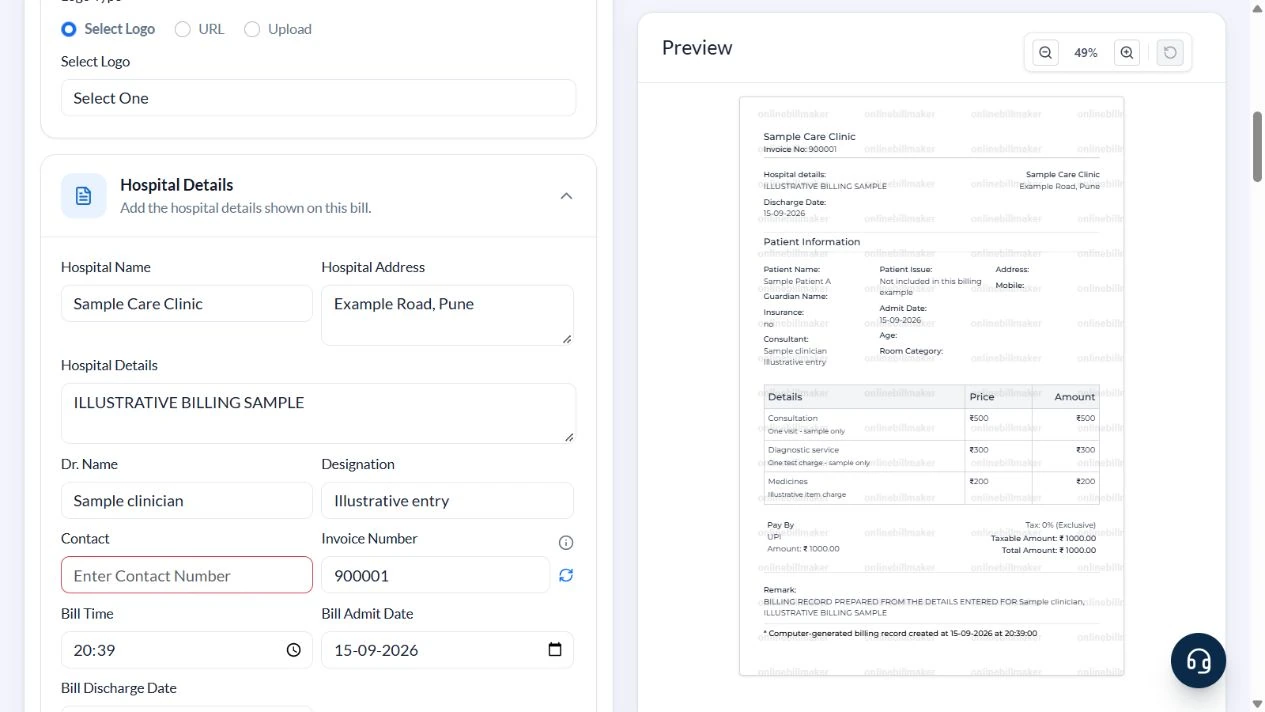
The example uses Template 1 of five layouts, Sample Care Clinic and the fictional label Sample Patient A. Both service dates are 15 September 2026. Consultation ₹500, a diagnostic service ₹300 and medicines ₹200 make ₹1,000. No real patient history, phone number or address is used.
The example uses Tax % 0 solely to demonstrate addition. Consultation, tests and goods must not be assigned one universal tax treatment merely because they appear on the same medical bill.
How do you read a medical invoice example?
A medical invoice example separates the patient, provider, dates and charges so each can be checked independently. In a sample medical invoice, first verify which visit the bill concerns. Then compare every description and amount with the original record, including any charge that appears similar to another line. A hospital receipt sample is useful for understanding a layout, but its illustrative names and amounts must not become facts in another person’s medical record.
Before you start: prepare and reconcile the details
A medical billing record should identify the correct visit without disclosing more health information than needed. Check whether the recipient needs the patient identifier, admission dates or a separate prescription, and keep unrelated clinical details out of a general expense sample. The person paying and the patient may be different people.
Compare service lines with the provider’s statement, including quantities for medicines and tests actually billed. A package price and the services already included in that package should not both be charged in full. Verify any deposit, refund or insurer settlement separately, because the gross expense and the patient’s remaining payment can differ.
Fields and sample values
| Field | Purpose | Sample value | When it applies |
|---|---|---|---|
| Hospital Name / Address / Details | Identify the billing provider. | Sample Care Clinic; Example Road, Pune | Use actual provider particulars for a real record. |
| Invoice Number | Identify this bill. | 900001 | The demonstrated field filters alphabetic characters; verify the rendered number. |
| Bill Admit Date / Bill Discharge Date | Dates printed on this hospital-style layout. | 15 September 2026 for both | A same-day example does not imply an inpatient stay. |
| Patient Name / Patient Issue | Patient label and optional context shown on the page. | Sample Patient A; no diagnosis included | Avoid adding sensitive history just to fill space. |
| Dr. Name / Designation | Provider information when relevant. | Sample clinician; illustrative entry | The form does not validate professional credentials. |
| Description / Details / Price / Total | Separate the billed services or goods. | Consultation; one visit; ₹500 | Template 1 has no visible quantity input in this table. |
| Payment Method / Tax % / Tax Calculation | Payment label and arithmetic settings. | UPI; 0%; Exclusive in this sample | Use the correct treatment for each real supply. |
Follow the editor step by step
Work through these stages in order. The screenshots show the actual editor running on localhost with illustrative details. Open a screenshot at full size when you need to read a field label; compare the values with your own source record.
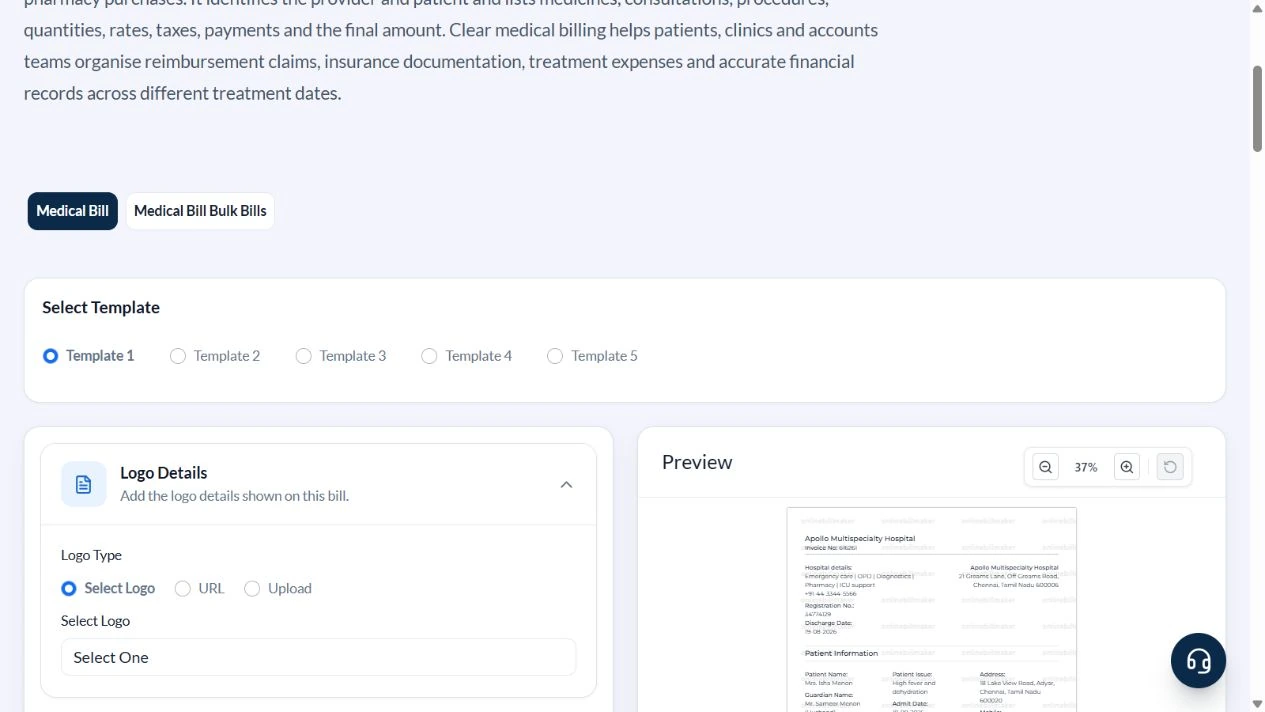
1. Select the hospital-style bill
Open Medical Bill and select Template 1. The page offers five layouts. This example uses the hospital-style form even though the illustrative charges are for one day.
2. Replace provider and patient defaults
Open Hospital Details and Patient Details. Enter Sample Care Clinic, Example Road, Pune, invoice 900001 and Sample Patient A. Set both dates to 15 September 2026. Clear unnecessary phone, address, guardian and age values; use an explicit sample label instead of a diagnosis. Leave Room at Select One.
3. Enter one charge per service
In Service Details keep the first row, remove the remaining defaults, then use Add Row twice. Enter Consultation 500, Diagnostic service 300 and Medicines 200. Each new row represents one charge in this layout. Check both Price and Total: an old default can contain a different stored line amount.
4. Read the completed billing copy
Choose UPI, Tax Type None and Tax % 0 for this illustration. The preview must show invoice 900001, the same-day dates and ₹1,000 total. Review patient fields for unnecessary information as carefully as the amount.
5. Review PDF and image options
The output section offers Download PDF and image formats PNG, JPG and WEBP with displayed credit costs. The local walkthrough inspected these controls; it did not purchase access or open a downloaded file.
After downloading: inspect the file before sharing
If you complete an eligible download, open the saved PDF or image and compare it with the preview. Check the first and last lines, long addresses, amounts, dates and any acknowledgement area. Confirm that every intended page is present and readable at the size the recipient will use. Keep the source record and payment evidence with the final file so the document can be reconciled later.
If you spot an error, return to the editor and correct the source field before generating the replacement. Use a clear file name with the document reference and period so an older draft is not accidentally sent as the final copy.
Three medical charge lines: ₹1,000
| Item | Basis | Result |
|---|---|---|
| Consultation | One illustrative visit | ₹500 |
| Diagnostic service | One illustrative test charge | ₹300 |
| Medicines | One illustrative item charge | ₹200 |
| Total | ₹500 + ₹300 + ₹200 | ₹1,000 |
These amounts demonstrate billing arithmetic, not recommended treatment or prices. If the source contains quantities, package adjustments or distinct tax treatment, choose a layout that represents them accurately; do not silently merge unlike charges.
What needs extra attention on a hospital final bill?
A hospital final bill format may include a period of care and several different charges. Check that the dates are consistent and that the same amount has not been entered twice under different descriptions. A patient invoice template should contain only the relevant patient details. Where the selected editor does not support an adjustment or additional medical schedule, keep that explanation with the provider’s original documentation rather than forcing it into an unrelated field.
What should accompany a reimbursement copy?
A medical bills reimbursement format helps organise information for review, but the insurer or employer sets the actual evidence requirements. A hospital bill sample PDF cannot establish treatment or approval. Compare the saved document with the issued original and retain required payment evidence. If a correction concerns clinical or provider information, obtain the appropriate provider-issued correction instead of treating an edited layout as authority to change those facts.
Troubleshooting and final checks
- Do not retain the prefilled hospital or patient identity after changing only the amount.
- Check invoice references in the preview: this field strips letters.
- Do not infer five days of room charges from a same-day service date or an old row description.
- A visible Insurance choice records an entered label; it is not an insurer decision.
- Keep diagnosis and contact details out of shared examples. Retain the original provider-issued documents for any recipient that requires them.
Editing and previewing are free. Downloads require sign-in and either an active plan or enough purchased credits: 5 credits for a PDF and 1 credit for an image. There are no free download credits. Free users see the platform watermark in the preview. Signed-in users with a credit balance or an active plan can choose a download format and preview without the watermark. Compare download credits and plans.
A user-entered medical record is not a prescription, proof of treatment or insurance approval. Use the provider-issued bill where required.