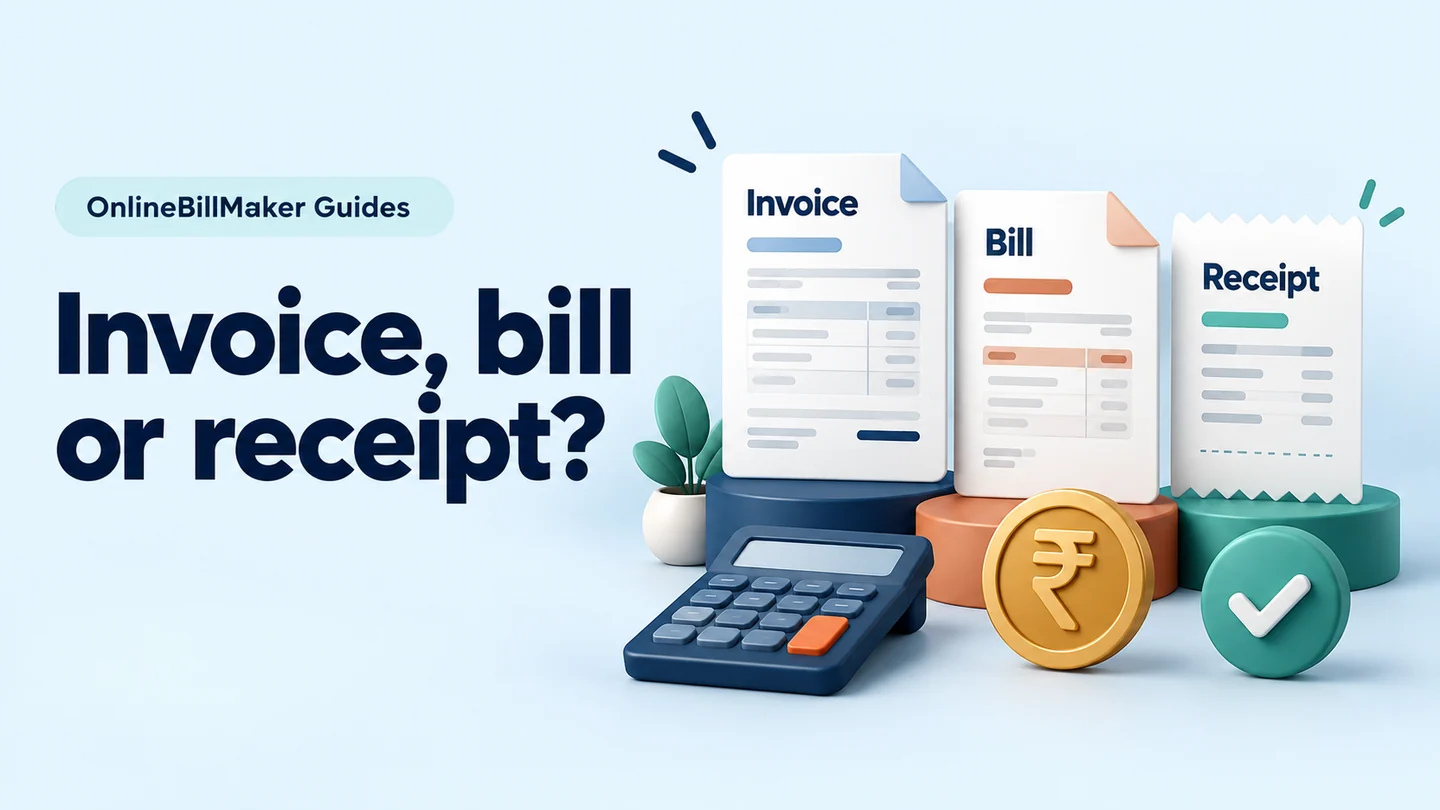
An invoice or bill sets out charges. A receipt acknowledges money received. The words invoice and bill often overlap in everyday trade; the useful distinction is what the document actually states about the supply, amount due and payment.
Compare the job of each document
| Record | Main question answered | Useful contents | Does it prove payment? |
|---|---|---|---|
| Invoice | What has the seller charged? | Seller, customer, items, date, reference, applicable tax and amount due | Not by itself |
| Bill | What is the charge for this purchase or service? | Itemised charges and total; often presented at the point of sale | Only if it also clearly acknowledges payment |
| Receipt | What money was received, when and for what? | Payer, recipient, amount, date, payment mode and linked reference | It records acknowledgement; retain the corresponding payment evidence |
One ₹2,000 transaction can need two records
A service provider bills ₹2,000 against reference INV-001. The customer pays ₹800 first. The invoice continues to describe the ₹2,000 charge; the payment receipt records ₹800 received and links it to INV-001. The outstanding balance is ₹2,000 − ₹800 = ₹1,200.
When the remaining ₹1,200 is received, record that settlement against the same invoice. Do not issue another ₹2,000 charge simply to acknowledge the second payment. Equally, do not label the first ₹800 receipt “paid in full”.
Choose fields for the transaction
A restaurant bill needs dishes, quantities and separately explained charges. A rent receipt needs the rental period, property, landlord, tenant and amount acknowledged. An e-commerce invoice links the seller’s charges to an order and its items. These are different information needs, even if all three documents contain a date and total.
Use a general bill when its fields describe the transaction adequately. Use the GST invoice particulars guide when a tax invoice is relevant. A heading or logo alone does not establish the document’s tax status.
Before filing or sharing
- Match the amount to the items and any adjustments.
- Keep invoice references separate from payment transaction IDs.
- State partial payment and balance clearly where applicable.
- Retain the issuer’s original record when a recipient requires it.
For the stage before a sale is agreed, read how a quotation becomes an invoice. For the order-entry workflow, follow the e-commerce invoice tutorial.
Step-by-step workflow
1. Identify the event you are documenting
Ask whether the record describes an amount being charged or money already received. If the transaction is only a proposal, begin with a quotation instead. A familiar title is less useful than a document that accurately describes the stage and purpose of the transaction.
2. List the underlying items or period
Record the supplier, customer, date, reference and the goods, services or rental period involved. Use quantities and rates when they explain the amount. A payment reference alone usually cannot tell the reader what was purchased, so preserve the itemised record as well.
3. Separate the billed and paid amounts
Show what is due and what was actually settled. For a partial payment, identify the amount received and the remaining balance rather than marking the whole transaction paid. Keep bank or cash acknowledgement evidence linked to the correct document reference.
4. File the connected records together
Retain the invoice or bill, the payment acknowledgement and any adjustment or refund record with a shared reference. Before sharing, verify that dates, parties and amounts agree. If a record is corrected, identify the replacement and keep the history understandable.
Understand partial payments, advances and refunds
An invoice for ₹2,000 followed by a ₹500 advance does not become a ₹500 invoice merely because that is the first transfer. The billed amount remains identifiable, while the receipt records ₹500 received and the account can show ₹1,500 outstanding. These separate facts help both parties reconcile the same transaction.
The word bill is often used informally for different commercial records. A restaurant bill may itemise a meal and also show settlement; a service bill may still be unpaid. Read the actual payment wording and evidence. Do not infer that payment happened just because a document looks like a receipt or contains a payment-method label.
A refund is another event. Keep the original purchase, the reason for the adjustment and the actual repayment evidence linked together. Replacing the old total with a smaller number can erase the explanation of what happened. Similarly, a corrected address should not make a replacement copy look like a second sale.