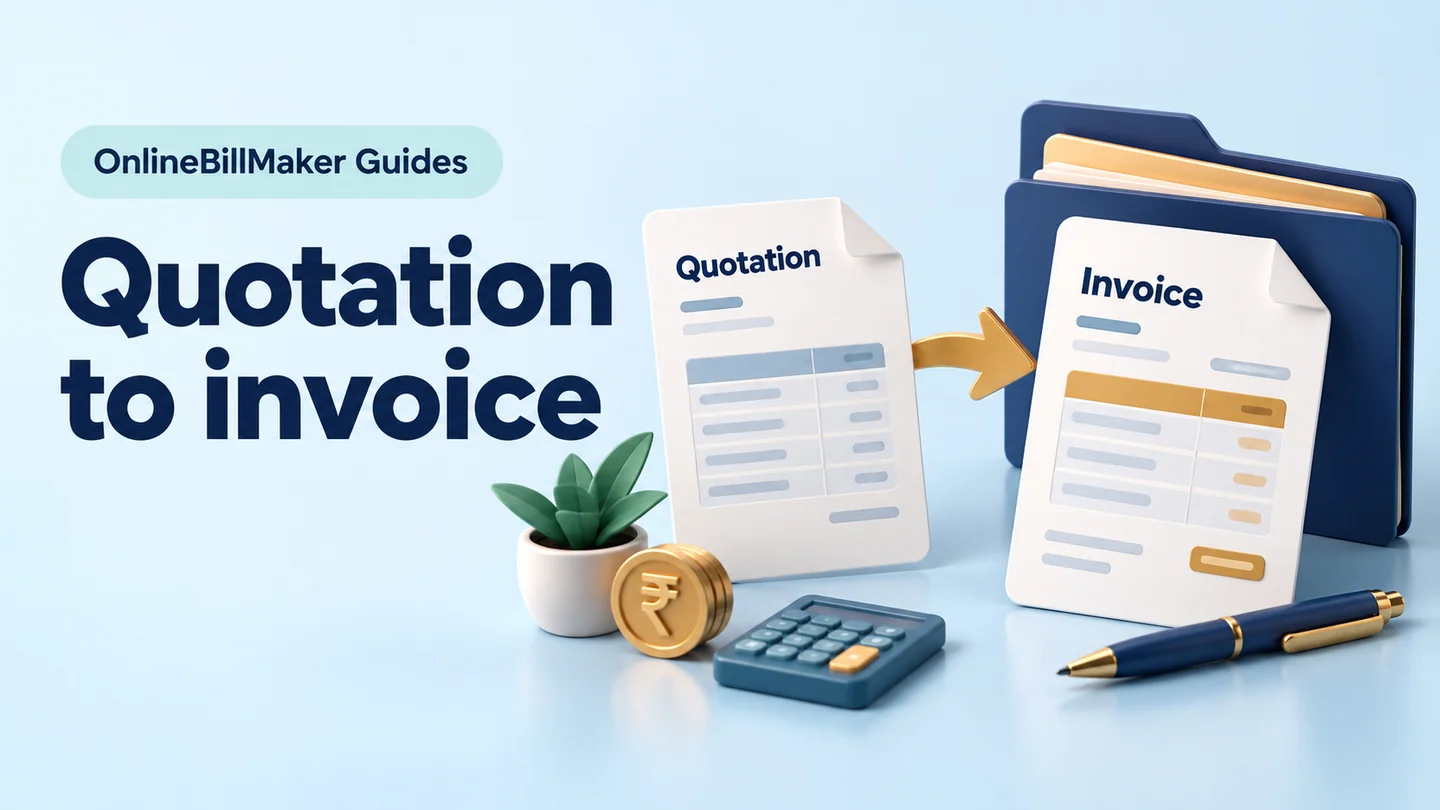
A quotation proposes work and its price before the customer agrees. An invoice bills the agreed supply at the appropriate stage. Moving from quote to invoice means carrying forward the accepted scope and recording changes, not just replacing the heading.
Start with a proposal the customer can assess
Suppose a freelancer quotes ₹20,000 for a five-page website. The quote includes design and implementation, one consolidated revision round and delivery after the client supplies final text. Hosting, copywriting and extra pages are excluded. The price example here excludes any separately applicable tax.
Give the quotation a reference, an issue date and a validity date. State what counts as acceptance and when work can start. A vague “website package” leaves both sides guessing when requests change.
Record what was accepted
The customer asks for one extra page at ₹2,000. Send a revised quotation totalling ₹22,000 and retain the acceptance. Mark the earlier version as superseded in your records. The agreed scope is now six pages; billing the first ₹20,000 quote would omit the change.
Connect the billing and payments
| Stage | Reference or record | Amount in this example |
|---|---|---|
| Original proposal | Q-001, five pages | ₹20,000 |
| Accepted revision | Q-001-R1, six pages | ₹22,000 |
| 40% advance under agreed terms | Linked request and payment acknowledgement | ₹8,800 |
| Remaining project amount | Final billing records with advance accounted for | ₹13,200 |
₹8,800 + ₹13,200 = ₹22,000. Show the advance adjustment without charging the same amount twice. The timing and type of any tax document depend on the applicable supply rules; the quote itself is not a substitute for required invoicing.
Review the handoff from quote to invoice
- Use the accepted revision and correct customer details.
- Identify the supplied items or completed milestone clearly.
- Carry over agreed exclusions and payment terms where relevant.
- Reconcile advances, credit adjustments and balance.
- Keep payment acknowledgement separate from the charge when needed.
Start in the quotation editor and follow its creation tutorial. Use the freelancer quotation format for a fuller scope example. If a customer requests a proforma, the three-document comparison explains its separate role.
Step-by-step workflow
1. Define and price the proposed scope
List the goods or deliverables, quantities, rates and exclusions before sending the quotation. Include validity and payment terms so the customer can assess the actual offer. A low total without an understandable scope makes later invoicing harder to reconcile.
2. Keep evidence of the accepted version
Record the quotation reference and the version the customer accepted through your normal process. If discussions change quantities, timelines or deliverables, update the proposal and obtain clear agreement. Do not rely on an old attachment when the final terms exist in a later revision.
3. Compare the accepted scope with actual supply
Before billing, check what was delivered and any agreed changes. Identify partial work, additional items or cancelled lines. Prepare the appropriate invoice particulars and dates from the real transaction rather than copying the proposal unchanged.
4. Issue the invoice and reconcile payments
Link the invoice to the accepted quotation where helpful, then distinguish the invoice value, advance received and remaining amount. Retain payment references and acknowledgement separately. Review the final file with the customer details, scope and total together before sending.
Manage revised scope without losing the agreed price
Suppose a designer quotes for a logo and two revision rounds, then the customer requests a brochure. The new deliverable needs an agreed scope and price; it should not appear as an unexplained extra on the final invoice. A revised quotation or documented change keeps the original commitment and the additional work understandable.
An advance does not necessarily reduce the value of the work. It reduces the amount still to be paid against that value. Keep the agreed project price and the received advance distinguishable so a customer does not mistake the balance due for the entire project cost. Use the actual tax and invoicing treatment applicable to the transaction.
A quotation’s validity date also deserves attention. If a customer accepts after the offer has expired, reconfirm that prices and delivery assumptions still apply. Do not silently bill a different amount later. Keeping document references and accepted versions together is often more useful than adding more decorative detail to the invoice.