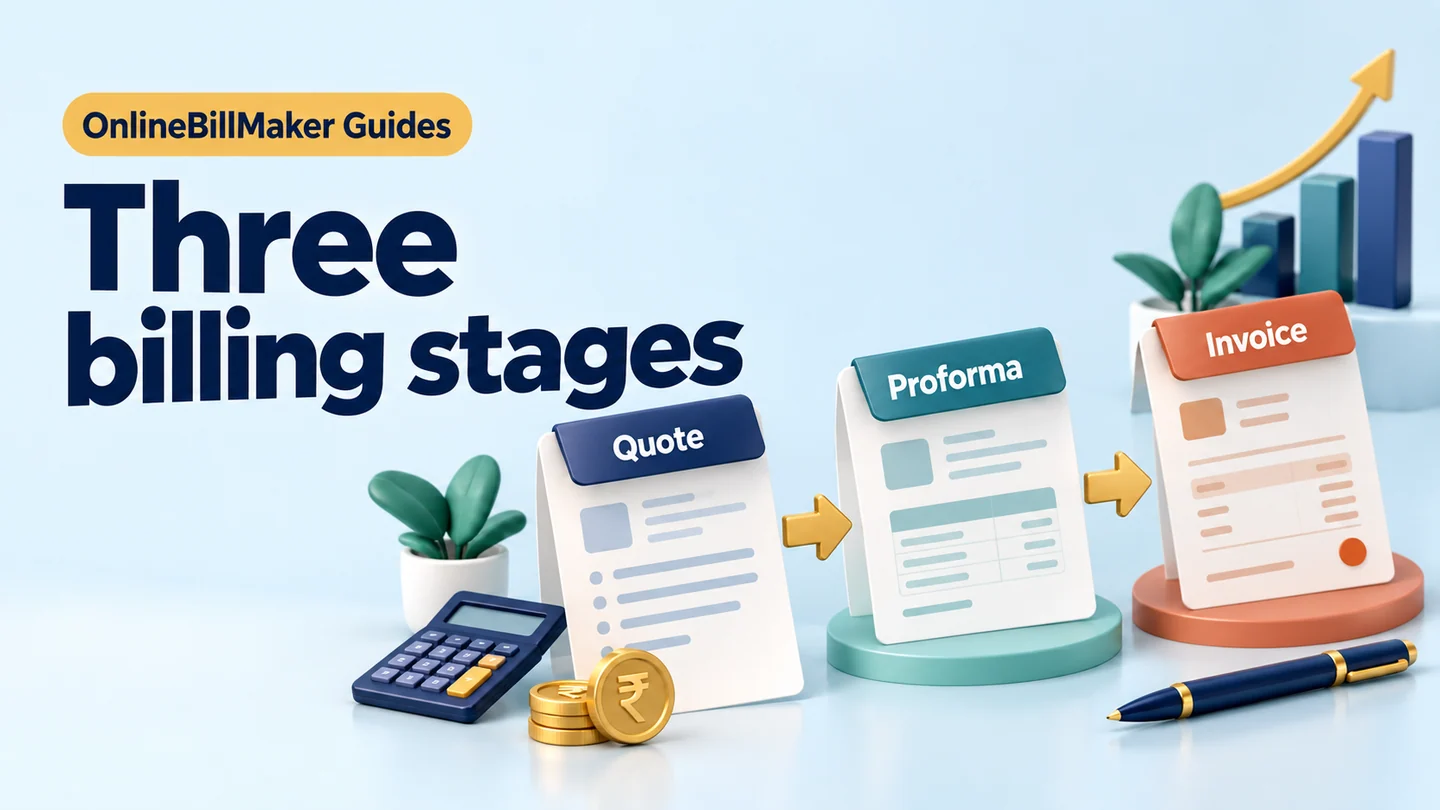
A quotation presents an offer. A proforma invoice sets out a proposed transaction in an invoice-like form. A tax invoice records a taxable supply under the applicable invoicing rules. A similar layout does not make the three documents interchangeable.
Purpose, timing and commitment
| Document | Usual purpose | Timing | What it does not establish alone |
|---|---|---|---|
| Quotation | Offer a defined scope and price for acceptance | Before agreement or for an agreed change | Supply, payment or tax credit |
| Proforma invoice | Summarise proposed items, delivery and payment expectations | Before final invoicing, often for approval or an advance request | A final tax invoice or completed payment |
| Tax invoice | Record the taxable supply and relevant tax particulars | At the time required for that supply | Payment merely because the invoice exists |
The commercial effect of an accepted offer depends on its terms and circumstances. Avoid universal statements that every quotation is non-binding or that a proforma always creates a payment obligation.
Worked order: proposed price to final record
A supplier quotes ten units at ₹1,000 each: ₹10,000 before tax. A proforma can repeat the agreed quantity and price, expected dispatch and payment instructions. If an illustrative 18% tax applies, the displayed proposed total is ₹10,000 + ₹1,800 = ₹11,800. That rate is an arithmetic assumption, not a classification of an unspecified item.
When the actual supply is invoiced, use its correct date, invoice reference, quantities and tax treatment. If only eight units are supplied at the same rate, the base is ₹8,000 and the assumed tax is ₹1,440, giving ₹9,440. Do not copy the ten-unit proforma unchanged.
An advance is also a separate event. Keep its payment acknowledgement and account for it in the final settlement. Do not treat a proforma as proof that the customer has paid.
Keep each reference identifiable
- Label a proforma clearly and distinguish its reference from the final invoice.
- State quote validity and any exclusions.
- Compare proposed and actual quantities before final billing.
- Confirm registration, classification, place of supply and tax particulars separately.
Use the quotation editor for an offer, the proforma editor for a preliminary record and the GST invoice editor when its fields match your required record. Read the proforma walkthrough, GST particulars guide and quote-to-invoice workflow for the next step.
Step-by-step workflow
1. Choose the document for the current stage
Use a quotation to set out an offer, a clearly labelled proforma for a preliminary transaction summary when needed, and the appropriate invoice for the actual supply and applicable requirements. Similar columns do not make these documents interchangeable.
2. Carry forward the agreed facts
Check parties, product or service descriptions, quantities, prices and delivery terms against the accepted proposal. Keep a shared order reference where useful, while making each document’s own identity clear. Review changes instead of mechanically copying the previous total.
3. Separate a payment request from payment received
A proforma may explain an expected advance or proposed amount. Record any actual payment through the proper acknowledgement and account records. Do not mark the transaction settled solely because a preliminary document has been sent.
4. Complete the final invoice review
Establish the actual supply details and invoice particulars, including relevant tax treatment. Complete any separately required official process. Keep the proposal, order, invoice and payment evidence connected so the buyer can trace the final charge back to what was agreed.
Use references to preserve the transaction history
A small order can pass through several documents without requiring the customer to pay several times. Give each record a clear title and reference, and show how it relates to the same underlying order. A quotation and proforma carrying similar amounts should not be counted as two sales or two payments in a summary.
Changes between stages should be explainable. A quantity may increase, delivery may be added or part of the proposal may be removed. Confirm the accepted change and use the actual final facts when invoicing. Keeping every document at the original proposed amount can be just as misleading as changing the total without explanation.
The right workflow depends on the transaction. A business does not need to create a proforma merely because a template exists, and a preliminary document cannot replace a required tax invoice. Start with the commercial purpose and applicable requirements, then choose the format that communicates that purpose accurately.