
Record school fees against the correct student and term. Keep tuition, library and other fee heads separate, and match the receipt to the institution’s payment record. Add the student reference, class, division and covered period before entering tuition and other fee components. Review amounts in figures and words, include a useful payment reference, and check who received the payment. This layout keeps the payment easy to trace while leaving admission status, concessions and remaining dues to the school’s own authorised records. Start with the school fee receipt generator for itemised payments.
The record and the example used here
A school fee receipt acknowledges an amount received. It should identify the student and fee period without implying that payment alone confirms admission or satisfies every fee obligation.
The walkthrough selects Template 2, the itemised option. Sample Learning School – DEMO records Student A – SAMPLE, class V, division A, GR number SAMPLE101 and Term 1, 2026–2027. The sample receipt is SAMPLE-SCH-001, dated 1 September 2026 at 10:30.
The receipt covers ₹12,000 tuition and ₹500 library fee, total ₹12,500. Its UPI reference is placed in Remarks because this layout has no separate transaction-reference or payment-mode control. No real student data is used.
What should a school receipt example explain?
A school receipt example should show which student, period and fee heads the payment covers. Compare the admission or student reference with the school record rather than relying on a name alone. In a school fee receipt sample, the printed payment date and the period may differ. Check both so a receipt for one term is not mistaken for a payment against another.
Before you start: prepare and reconcile the details
Identify the student using both name and the institution’s student or GR reference when available. Students with similar names can otherwise be confused. Keep the academic year or term visible, because a payment made today may settle an earlier term rather than the current month.
Compare the fee heads with the school’s approved statement. Tuition, transport, activities and other charges should be distinguishable, and a concession should follow the institution’s records. Reconcile the amount in words after editing figures. A receipt acknowledges the stated payment; it should not imply that all future fees or admission conditions are satisfied.
Fields and sample values
| Field | Purpose | Sample value | When it applies |
|---|---|---|---|
| School Name / School Address | Identify the receiving institution. | Sample Learning School – DEMO; Example Road, Pune | The template does not verify school authorisation. |
| Receipt No. / Receipt Date / Receipt Time | Reference the payment acknowledgement. | SAMPLE-SCH-001; 1 September 2026; 10:30 | Keep the school’s issued reference for an actual receipt. |
| Student Name / GR No. | Identify the student account. | Student A – SAMPLE; SAMPLE101 | Use only necessary student information. |
| Std. / Div. / Period | Specify class and fee coverage. | V; A; Term 1, 2026–2027 | Period is typed text, not an academic-calendar calculation. |
| Particular / Amount | Separate fee heads and amounts received. | Term 1 tuition ₹12,000; library ₹500 | Amounts are added automatically. |
| Total Amount / Amount in Words | Display the sum and wording. | ₹12,500; Twelve Thousand Five Hundred | Both follow the item amounts; do not try to overwrite the read-only total. |
| Remarks / Received By | Record reference and receiving desk. | UPI reference SAMPLE-PAY-001; Sample accounts desk | Keep transfer evidence with the receipt. |
| Footer notes / Stamp URL | Use appropriate acknowledgement text. | Admission status not confirmed here; stamp URL blank | A graphic does not authenticate a school receipt. |
Follow the editor step by step
Work through these stages in order. The screenshots show the actual editor running on localhost with illustrative details. Open a screenshot at full size when you need to read a field label; compare the values with your own source record.
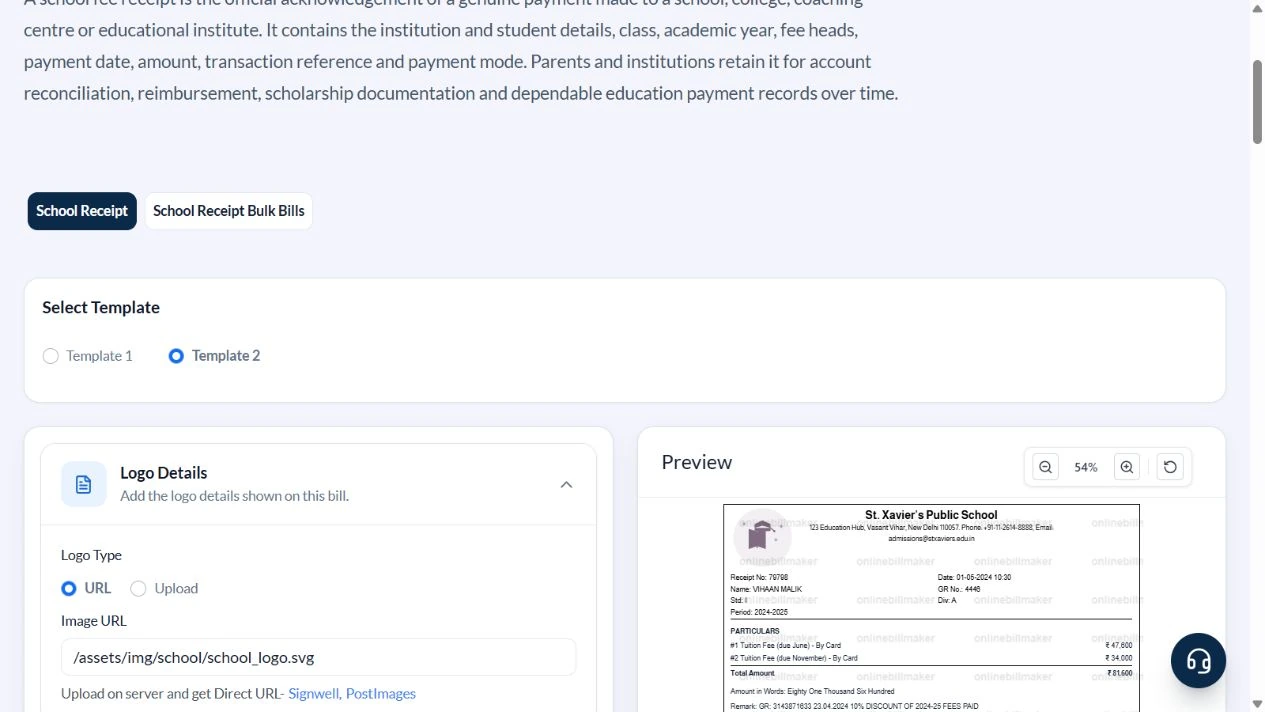
1. Choose the detailed school layout
Select Template 2. Template 1 is a short acknowledgement; Template 2 exposes student class, division, period and itemised Particulars.
2. Identify the student and term
Enter Sample Learning School – DEMO and Example Road, Pune. Use Student A – SAMPLE, GR No. SAMPLE101, Std. V, Div. A and Period Term 1, 2026–2027. Set SAMPLE-SCH-001 and 1 September 2026 at 10:30 in Receipt Details.
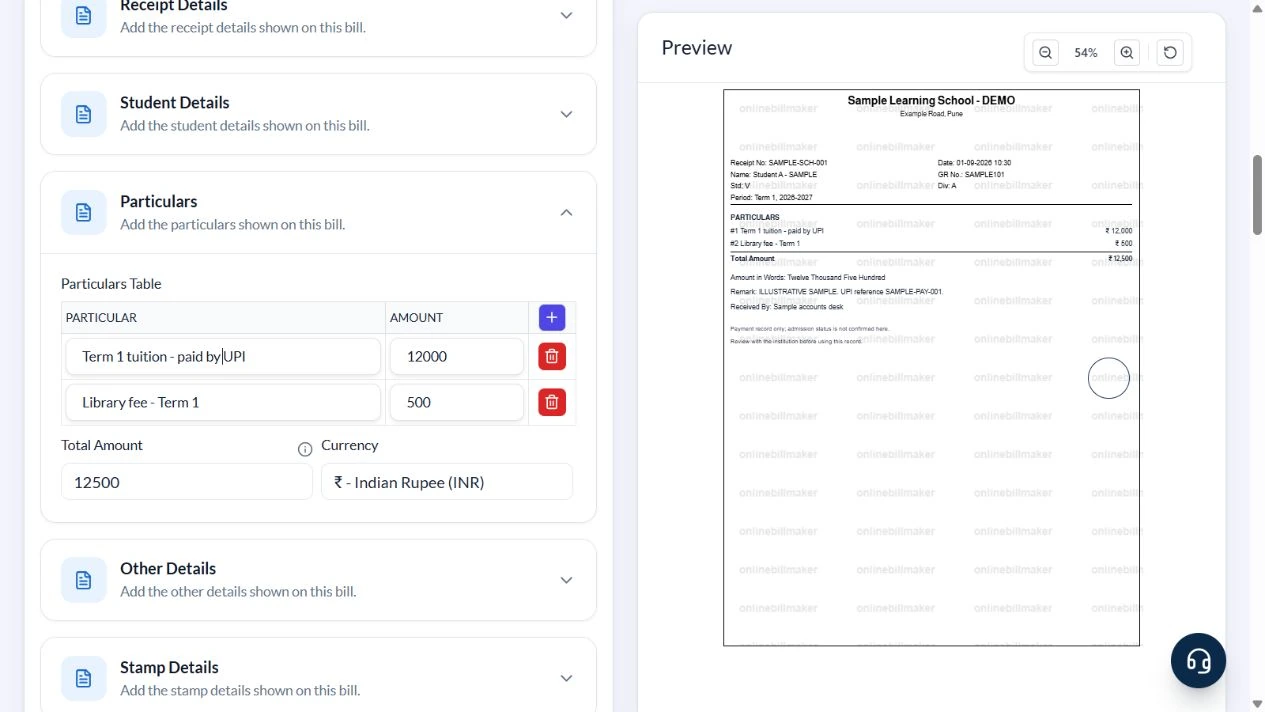
3. Enter each fee amount
In Particulars, enter Term 1 tuition – paid by UPI with 12000 and Library fee – Term 1 with 500. Total Amount updates to 12500 and Amount in Words becomes Twelve Thousand Five Hundred. Put ILLUSTRATIVE SAMPLE and UPI reference SAMPLE-PAY-001 in Remarks.
4. Review the institution acknowledgement
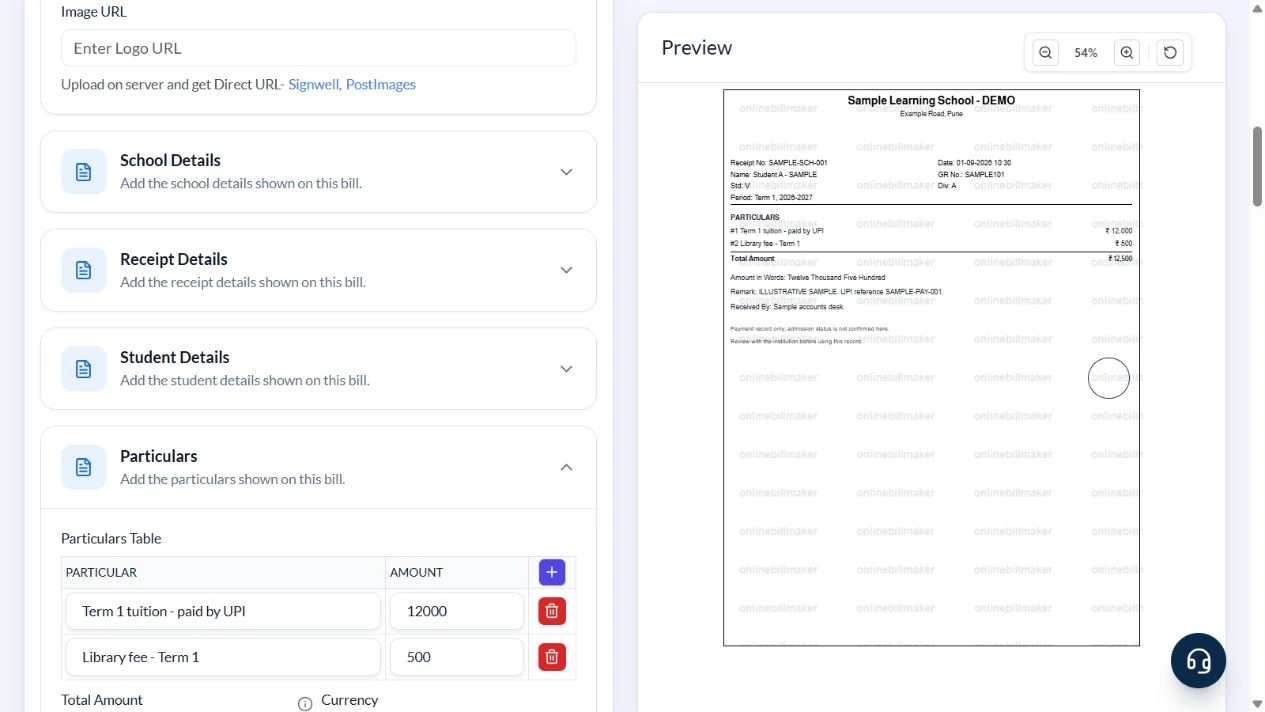
Use Sample accounts desk under Received By. Replace default admission and signature claims with Payment record only; admission status is not confirmed here and Review with the institution before using this record. Clear the logo and stamp URLs. Check ₹12,500, the term and student details in the preview.
5. Check the output stage
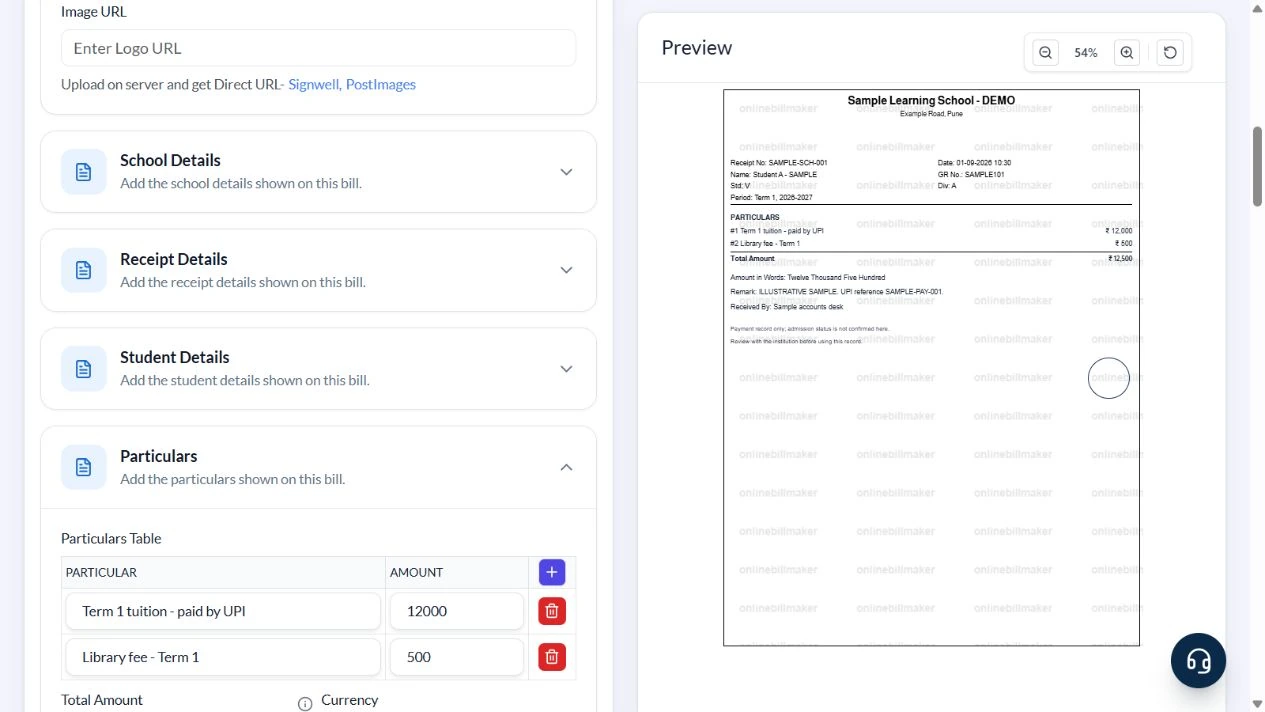
Review the PDF and image controls and current access conditions. This walkthrough captured the available options without purchasing or inspecting an exported file.
After downloading: inspect the file before sharing
If you complete an eligible download, open the saved PDF or image and compare it with the preview. Check the first and last lines, long addresses, amounts, dates and any acknowledgement area. Confirm that every intended page is present and readable at the size the recipient will use. Keep the source record and payment evidence with the final file so the document can be reconciled later.
If you spot an error, return to the editor and correct the source field before generating the replacement. Use a clear file name with the document reference and period so an older draft is not accidentally sent as the final copy.
A term receipt for ₹12,500
| Item | Basis | Result |
|---|---|---|
| Tuition received | Term 1, 2026–2027 | ₹12,000 |
| Library fee received | Same term | ₹500 |
| Receipt total | ₹12,000 + ₹500 | ₹12,500 |
| Payment reference | Illustrative UPI reference in Remarks | SAMPLE-PAY-001 |
This receipt covers the two entered payments. It does not calculate the student’s annual fee, scholarships, unpaid instalments or overall account balance. Use the school ledger for those checks.
How do you review the fee calculation?
A school fee receipt calculation starts with the individual fee heads and adds only the amounts included in the payment. Check the tuition fee amount separately from any admission or exam charge. If the institution records concessions or earlier balances outside this layout, retain that reconciliation separately. Do not change a fee label to make a partial payment appear to settle an entire term.
How do you keep the final copy useful?
When learning how to make a school fee receipt, finish by comparing the saved document with the school’s authorised records. A school fee receipt download should remain legible and clearly identify its payment reference. Keep any acknowledgement or signature authorised by the institution. If a parent needs a corrected issued receipt, obtain it through the school’s process rather than treating an independently edited copy as the official original.
Troubleshooting and final checks
- Do not mix the payment date with the academic period.
- Use amounts actually received rather than the entire annual fee when issuing a partial-payment receipt.
- Replace default admission or cheque-realisation statements if they do not apply.
- Check that Amount in Words agrees with the total after editing rows.
Editing and previewing are free. Downloads require sign-in and either an active plan or enough purchased credits: 5 credits for a PDF and 1 credit for an image. There are no free download credits. Free users see the platform watermark in the preview. Signed-in users with a credit balance or an active plan can choose a download format and preview without the watermark. Compare download credits and plans.
A user-created school record is not an institution-issued acknowledgement unless the authorised institution reviews and issues it.